


“Manipulators view boundaries as the starting point of negotiations."
Assertive Boundary Setting: How To Say “No” and Get Results
Most emotionally healthy people understand that everyone has the right to make their own decisions. They may not like hearing "no," but they accept it because they recognize that another person's boundaries are not theirs to negotiate.
Manipulative and controlling individuals often see the situation differently. Rather than accepting a refusal, they immediately begin looking for ways around it. They ask for an explanation, suggest alternatives, minimize your concerns, or insist that you misunderstood what they meant. To them, your first answer is not always viewed as final. It is simply the starting point for another attempt.
This is one reason predators and manipulators frequently test boundaries before they attempt anything more serious. As we discussed in the previous article, the goal is often not the request itself. The goal is learning how someone responds when their decision is challenged. A person who changes their answer under pressure communicates something very different than someone whose boundary remains firm.

"No" Is A Complete Sentence
Many people assume that if they simply provide a good enough reason, the other person will understand and respect their decision. While that may be true with emotionally mature people, it often has the opposite effect with someone who is determined to get their way.
Imagine declining an invitation by saying you're too busy. A respectful person will usually accept that answer and move on. A manipulative person may respond by suggesting another day, offering to help with your schedule, or assuring you that it won't take much time. Suddenly, the conversation isn't about whether you wanted to go. It has become a discussion about solving the reason you gave for saying no.
This happens because explanations give persistent people something to work with. Every reason can be challenged, minimized, or negotiated. The more information you provide, the more opportunities someone has to continue the conversation. That doesn't mean you should never explain yourself, but it does mean recognizing when an explanation is serving you and when it is serving the other person.

A Boundary Is Not a Negotiation
One of the healthiest mindset shifts you can make is understanding that boundaries are statements, not opening offers. They are not invitations to debate, compromise, or persuade. They simply communicate where your comfort level begins and ends.
Consider the difference between these two responses. One person says, "I'm sorry, but I have a lot going on right now. Maybe another time." Another simply says, "No, thank you." Both answers decline the request, but they communicate very different levels of certainty. The first leaves the impression that the answer might change if the circumstances change. The second communicates that the decision has already been made.
This does not mean you should become abrupt or unfriendly. Kindness and confidence are not opposites. In fact, the most effective boundaries are often delivered calmly, respectfully, and without unnecessary emotion.
The confidence comes from understanding that your decision does not require someone else's approval.
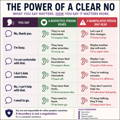
“Body language is just as important as the words coming out of your mouth.”
Your Response Communicates More Than Just Words
Whether we realize it or not, our responses communicate far more than the words we choose. People pay attention to hesitation, uncertainty, and inconsistency just as much as they listen to what we actually say. Someone who immediately begins apologizing for a boundary may unintentionally signal that they are uncomfortable enforcing it.
That does not mean you should never apologize or never be polite. It simply means recognizing that confidence is often communicated through consistency. When your words, tone, and actions all reinforce the same message, there is far less room for someone to believe they can change your mind.
This is why manipulative people often continue pushing after they receive an uncertain response but quickly move on when they encounter someone who is calm, respectful, and unwavering. They are not necessarily responding to the word "no." They are responding to the confidence behind it.

When Someone Refuses to Accept Your Answer
Unfortunately, not everyone respects boundaries, no matter how clearly they are communicated. Some people continue asking because they believe persistence will eventually pay off. Others simply feel entitled to your time, attention, or compliance. In either case, continuing to explain yourself rarely improves the situation.
When someone repeatedly ignores a clear boundary, the goal should no longer be convincing them to understand your decision. The goal should be ending the interaction. That may mean walking away, changing the subject, ending the conversation, or leaving the area entirely.
Continuing to engage with someone who has already demonstrated a lack of respect for your boundaries often gives them exactly what they want: more opportunities to pressure you.
There is another important lesson hidden in these interactions. People reveal a great deal about themselves by how they respond to hearing the word "no." Respectful people accept it.
Manipulative people challenge it. That distinction can tell you far more about someone's character than almost anything they say about themselves.
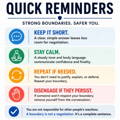
Learning to say "no" is an important skill, but learning to let that answer stand is even more important. Personal safety is not just about recognizing dangerous situations. It is also about recognizing people who refuse to respect healthy boundaries. The moment someone treats your decision as something to overcome rather than something to respect, they are providing valuable information about themselves.
You are not responsible for making everyone happy, and you are not obligated to provide a detailed defense of every personal decision you make. Healthy relationships, whether with friends, coworkers, family members, or strangers, are built on mutual respect. That respect includes accepting another person's boundaries, even when the answer isn't the one you hoped to hear.
The next time someone continues pushing after you've already said no, pay attention to what is really happening. The conversation is no longer about the favor, the invitation, or the request. It has become a measure of whether your boundary will remain in place under pressure. The strongest response is not the loudest or the most confrontational. It is simply having the confidence to let your answer remain exactly what it was the first time you said it.
Defense Divas® wants you to be equipped to defend yourself not only with a self-defense weapon, but also with the practical knowledge of safety awareness and prevention.
Follow us on your favorite social media platforms (@DefenseDivas) to receive safety tips, product videos and more in your daily feed. Leave us a comment and introduce yourself too!
Copyright©2026 All rights reserved. This article or any portion thereof may not be reproduced or used in any manner whatsoever without the express written permission of Defense Divas®.