

Gain a basic understanding of how stun guns work, their benefits, voltage differences, stun gun vs. TASER technology, effective use, safety, practice and legal considerations.
APR 23, 2017 | UPDATED SEP 16, 2026
Stun Guns 101 -Basics of Electric Self-Defense
Stun guns have been a popular personal-protection option for decades, and it is easy to understand why. They are compact, reusable, easy to carry and capable of producing an intimidating electrical arc at the push of a button. Many models also incorporate practical everyday features such as flashlights, alarms, rechargeable batteries and disable-pin wrist straps.
Stun guns are permitted in many areas where firearms are not. Furthermore, a stun gun may be the best self-protection solution for a person who is not permitted by law, for whatever reason, to own or carry a firearm. There are also moral, ethical or religious reasons that a person may opt for a stun gun in self protection instead of a firearm.
But not every electrical self-defense device works the same way. One of the biggest sources of confusion is the difference between a traditional contact stun gun and a TASER® energy weapon. Understanding those differences, along with how to carry, maintain and operate your particular device, can help you make better decisions about your personal safety.
Here is your crash course in electrical self-defense.
Stun guns are a very popular and effective method of non-lethal self-defense. The questions and answers below are some of the most common ones that an individual may have when considering a stun gun for their method of self protection.
“The goal of any non-lethal self-defense weapon is to incapacitate your attacker, providing you an opportunity to escape. ”
⚡️What Is A Stun Gun?
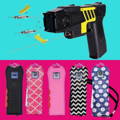
⚡️What’s the Difference Between a Stun Gun and a TASER®?

⚡️How Does a Stun Gun Work?
A traditional stun gun contains electrodes separated by a small distance. When the device is activated, you may see electricity arc between those contacts and hear the characteristic crackling sound.
When the electrodes are pressed against an attacker, the electrical energy is delivered at the point of contact. The resulting sensation can be painful and startling and cause involuntary localized muscular reactions.
Biologically, a stun gun is designed to attack the nervous system by administering a high amount of electrical energy into the system at a different vibration than the pulse waves coming from the brain. When these two energies collide at the nerve level, it affects how muscles react; resulting in muscle contractions and spasm.
A TASER® energy weapon operates differently. Because its deployed probes can be separated across a larger area of the body, an effective probe deployment is designed to interfere with voluntary muscle control through neuromuscular incapacitation.
This distinction is why you shouldn't judge a contact stun gun by expecting it to behave exactly like the TASER deployments you've seen in police videos. They are different electrical self-defense technologies designed to work in different ways.
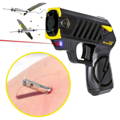
⚡️How Long Does It Take for A Stun Gun to Work?
You may have seen charts claiming that one second of contact causes one reaction, three seconds another and five seconds guarantees incapacitation. Human beings and stun guns simply have too many variables for those charts to be treated as guarantees.
Simply put, there is no “magic amount of time”. The response can depend on the particular device, quality of contact, thickness of clothing, placement of the device and the individual involved. An attacker who is under the influence of alcohol or drugs may respond differently than one who isn't.
For self-defense purposes, the more useful principle is simple: use your defensive tool to create an opportunity to escape. You should apply your stun gun’s electrical jolt for the number of split seconds it takes to disrupt your attacker and provide you an effective escape to safety.
If an attacker releases you, recoils or otherwise gives you an opening, take it. Create distance, get to a safer location and call for help. You don't earn extra points for remaining in a confrontation longer than necessary. After you reach safety, you can call the police and let them handle the distribution of justice.
⚡️What Does a Stun Gun Feel Like?
⚡️Pepper Spray or Stun Gun Self-Defense?
Why choose between them solely on the basis of which one is "better"? They solve different self-defense problems.
Pepper spray offers the tremendous advantage of distance. Depending upon the particular product, it can potentially be deployed before someone reaches you. That makes it valuable when you recognize a threat while there is still space between you and the other person. The effects of pepper spray last much longer but it is not a good self-defense weapon if you are grabbed from behind.
A stun gun works much faster at stopping an attacker but they have to be within arm's reach to deploy the stun gun. An attacker will recover sufficiently from a stun gun current in a few minutes, but the effects of pepper spray can last up to 60 minutes.
A stun gun provides a close-contact defensive option. That becomes particularly relevant if someone has already closed the distance, grabbed you or prevented you from easily getting away.
Some people choose to incorporate both concepts into a layered personal-safety plan: a distance option and a close-contact option. Whatever you carry, accessibility matters. A powerful self-defense device buried underneath everything in the bottom of your purse isn't nearly as useful as one you can quickly reach when circumstances begin to deteriorate.
There are pros and cons to each of these self-defense weapons and in all honesty, you should be carrying both.
There are multiple factors to consider when comparing the two forms of self-defense. We encourage you to read the following articles to consider all the aspects.
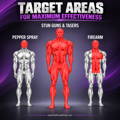
"Stun guns have the largest effective strike zone of all self-defense options because they target large muscle groups.”
⚡️Where Are the Best Places on the Body to Apply a Stun Device?
⚡️Can the Current from My Stun Gun Pass Through My Attacker to Me?
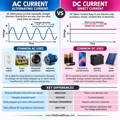
⚡️What’s the Difference in Stun Gun Voltages?
Voltage has dominated stun gun marketing for years, which is why you'll see dramatically different voltage claims among products.
Higher voltage can help electricity overcome resistance and establish an electrical path, including across certain clothing barriers. But voltage alone does not tell you everything about a stun gun's electrical performance.
Electrical output also involves factors such as current, pulse characteristics, duration and electrode design. Consequently, you shouldn't automatically assume that the product displaying the largest voltage number on the package must be the best stun gun.
There are other features worth considering when choosing a device: overall construction, comfortable grip, size, electrode configuration, safety switch, rechargeable versus replaceable batteries, accessibility of the activation control and additional features such as a flashlight, alarm or disable pin.
The best specifications in the world aren't particularly helpful if the device is too large for you to carry consistently or its controls are awkward for you to operate.
Higher voltage stun guns create a much louder electric shock which is often an effective intimidator by itself to both humans and animals.
⚡️Will it Damage My Stun Gun if I Practice?
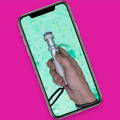
Practicing with your stun gun is an important part of responsible ownership, but practice doesn't mean repeatedly shocking objects or holding the button down continuously with not grounding contact.
Start with handling skills. Learn how to remove the device from its holster or your preferred carry location, establish your grip, disengage the safety and find the activation button without fumbling.
Many manufacturers allow brief test firing to verify operation, but follow the instructions for your specific model regarding how long and how frequently it should be activated without contact.
Battery maintenance matters too. Rechargeable stun guns should be charged according to the manufacturer's instructions rather than waiting until the battery is completely dead. If your device uses replaceable batteries, inspect and replace them as recommended.
A stun gun you haven't touched in two years shouldn't be assumed to be ready simply because it worked the day you bought it.
⚡️Are Stun Guns Legal in My State?
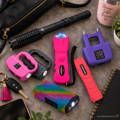
Stun gun laws have changed substantially over the years, so don't rely on an old online chart or assume the rules are identical everywhere.
State and local laws may address possession, carrying, age requirements and locations where electrical self-defense devices are prohibited. Rules can also be different when you travel outside your home state.
Before purchasing or carrying a stun gun or TASER energy weapon, verify the current laws where you live and anywhere you intend to carry it. Pay particular attention to restricted locations such as schools, government buildings, courthouses and other facilities that may have their own rules.
Some states also may require you to have a concealed carry permit or purchase from a firearms dealer that is licensed to sell firearms in that particular state. Contact your local law enforcement office and they will be able to provide you with the laws in your area.
You must be 18 years old to purchase a stun gun from Defense Divas®.
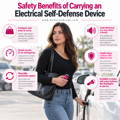
Owning a self-defense device is only part of being prepared.
Know how your stun gun operates. Keep it charged and accessible. Practice retrieving and activating it safely. Pay attention to your surroundings so you have the earliest possible warning that something isn't right.
Stun guns offer several qualities that make them an attractive personal-protection option: they can be compact, affordable, reusable, easy to operate and available in configurations suitable for different lifestyles. The electrical arc itself may provide a valuable deterrent before physical contact becomes necessary, while the contact capability gives you an additional defensive option if someone gets close enough to grab or attack you.
No single tool replaces awareness and good decision-making. But when a dangerous encounter moves from avoidance to physical confrontation, having a self-defense option you know how to use can give you another opportunity to break contact, escape and get to safety.
Defense Divas® wants to educate and empower you to embrace your right to defend yourself. We offer a large selection of both stun guns and TASER® weapons for you to choose from and are here to answer any questions.
Knowledge is power. Explore our many articles and learn more valuable self-defense and safety awareness tips to incorporate into your life.
The Legal Stuff: TASER® is a trademark of Axon Enterprises, Inc., registered in the U.S. and other countries.
Copyright©2026 All rights reserved. This article or any portion thereof may not be reproduced or used in any manner whatsoever without the express written permission of Defense Divas®.