


“The FBI reports that a violent crime of any type (murder, rape, robbery, or aggravated assault) occurs every 25.9 seconds."
How Criminals Choose Their Targets (And How To Avoid It)
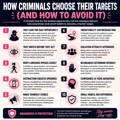
When people think about crime, they often imagine that victims are chosen randomly. While some crimes are crimes of opportunity, many offenders make deliberate decisions about who they target and when.
The good news is that criminals are not typically looking for the strongest, fastest, or most physically capable person. More often, they are looking for the easiest opportunity.
Understanding how criminals identify potential targets can help you make small adjustments that reduce vulnerability and increase personal safety. This is not about living in fear or becoming suspicious of everyone around you. It is about recognizing how offenders think and understanding how simple habits can make you a less attractive target.
The goal of personal safety is not to become impossible to victimize. The goal is to become a harder target than the offender is willing to deal with.
Most Criminals Are Looking for Opportunity, Not Challenge
Contrary to what movies often portray, many criminals are not seeking confrontation. They are seeking convenience.
Whether the crime involves theft, robbery, assault, or another offense, offenders generally prefer situations that minimize risk and maximize control. They want to avoid attention, witnesses, resistance, and anything that increases the chance of being caught.
This means they often look for people who appear distracted, isolated, unaware of their surroundings, or unlikely to react quickly.
In many cases, the offender's decision is less about the victim personally and more about the circumstances surrounding them. The easier the opportunity appears, the more attractive it becomes.

Criminals Often Watch Before They Act
Many crimes involve a period of observation before any action takes place.
An offender may watch how a person moves through an environment, whether they are paying attention, how they respond to their surroundings, and whether they appear confident or vulnerable. This observation can happen in a matter of seconds or over a longer period of time.
For example, someone walking through a parking lot while focused entirely on their phone may signal a very different level of awareness than someone who is scanning their surroundings and moving with purpose. One person appears distracted. The other appears alert. From an offender's perspective, those differences matter.
Body Language Communicates More Than You Realize
Long before a conversation ever takes place, people communicate through body language.
Research into victim selection has suggested that offenders often pay attention to how people walk, carry themselves, and move through their environment. They are looking for clues about confidence, awareness, and the likelihood of resistance.
Someone who appears lost, uncertain, or disconnected from their surroundings may attract more attention than someone who moves with purpose and confidence. Focus on appearing aware and self-assured. Keeping your head up, maintaining good posture, and moving decisively can communicate that you are paying attention and capable of responding if something seems wrong.

Distraction Creates Opportunity
One of the most common characteristics offenders look for is distraction.
Modern life provides countless opportunities to become disconnected from our surroundings. Phones, earbuds, texting, social media, navigation apps, and endless notifications compete for our attention every day.
While technology is useful, it can also create blind spots. A distracted person may not notice someone approaching. They may fail to recognize unusual behavior. They may miss opportunities to avoid a developing problem before it becomes serious.
Awareness is one of the simplest and most effective safety tools available. It costs nothing, requires no equipment, and can dramatically improve your ability to recognize and respond to potential threats.
“Change up your routine on a regular basis. Predictability makes you a soft target.”
Predictability Can Increase Risk
Humans naturally love routine. We leave for work at the same time, stop at the same stores, park in the same places, and follow the same routes. Routine makes life easier, but it also makes behavior more predictable.
Most people never need to worry about someone monitoring their schedule. However, predictability can create opportunities for those who do have harmful intentions.
This is one reason security professionals often recommend varying routines when possible. Small changes can make it more difficult for someone to anticipate your movements and habits.
You do not need to live unpredictably. Simply avoiding rigid patterns can reduce unnecessary exposure.
Isolation Is Often Attractive to Offenders
Many offenders prefer situations where intervention is unlikely.
A person walking alone in a poorly populated area may appear more vulnerable than someone surrounded by other people. Likewise, isolated parking areas, empty stairwells, deserted walking paths, and poorly lit locations can create environments where offenders feel more comfortable acting.
This does not mean avoiding every quiet place. It means understanding how environment influences risk. Whenever possible, choose routes, parking spaces, and locations that increase visibility and access to other people. Being seen often acts as a powerful deterrent.
Politeness Can Be Exploited
One topic that deserves more attention is the role of social conditioning.
Many people are taught from a young age to be polite, accommodating, and agreeable. While these qualities are valuable, they can sometimes be exploited by manipulative individuals.
Criminals and predators often test boundaries before committing more serious acts. They may ask for unusual favors, invade personal space, pressure someone into continuing a conversation, or create situations designed to make a person uncomfortable.
What they are often looking for is not compliance with a specific request. They are looking to see whether boundaries can be crossed without consequence.
People who trust their instincts and enforce boundaries early are often much harder to manipulate.

Confidence Is Not the Same as Fearlessness
One common misconception is that safe people are fearless people. In reality, confidence has very little to do with fear and everything to do with awareness and decision-making.
Confident individuals still experience uncertainty, discomfort, and concern. The difference is that they trust themselves enough to respond. They are more likely to leave a situation that feels wrong. They are more willing to say no. They are less likely to ignore warning signs simply to avoid awkwardness.
Confidence is not about believing nothing bad will happen. It is about believing you can make good decisions if something does.
Becoming a Harder Target
Personal safety is often portrayed as something dramatic, but the most effective changes are usually simple.
Small habits can significantly reduce vulnerability:
• Pay attention to your surroundings when moving through public spaces.
• Keep your head up rather than focusing entirely on your phone.
• Trust discomfort instead of immediately dismissing it.
• Set boundaries early and confidently.
• Choose visible, populated areas whenever possible.
• Avoid becoming overly predictable in your daily routines.
None of these habits require special training. They simply make you more aware, more prepared, and less attractive to someone looking for an easy opportunity.

The Goal Is Awareness, Not Fear
Learning how criminals select targets is not about becoming suspicious of everyone you encounter. It is about understanding that many offenders make decisions based on opportunity and perceived vulnerability.
The encouraging reality is that small changes in awareness, confidence, and behavior can have a significant impact on how others perceive you.
Most criminals are looking for the path of least resistance. By paying attention, maintaining boundaries, and moving through the world with awareness, you make yourself a less appealing option.
Personal safety is not about living in fear. It is about living with enough awareness to recognize risk, trust your instincts, and make decisions that help you stay safe.
Defense Divas® wants you to be equipped to defend yourself not only with a self-defense weapon, but also with the practical knowledge of safety awareness and prevention.
Follow us on your favorite social media platforms (@DefenseDivas) to receive safety tips, product videos and more in your daily feed. Leave us a comment and introduce yourself too!
Copyright©2026 All rights reserved. This article or any portion thereof may not be reproduced or used in any manner whatsoever without the express written permission of Defense Divas®.