

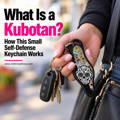
“The kubotan appears as an innocuous key fob to the untrained eye.”
A kubotan doesn't look particularly intimidating. It is small enough to fit in your hand, light enough to carry with your keys and simple enough that there are no batteries to charge, safety mechanisms to disengage or complicated parts to operate. Yet this compact self-defense tool has been around for decades.
A traditional kubotan is essentially a short, rigid handheld stick that can provide a stronger striking surface, help protect the hand and concentrate force into a smaller area. Modern versions come in numerous shapes and materials, from simple polymer sticks to aluminum keychain designs and flatter, contoured variations.
Its simplicity is part of the appeal. It is also why understanding what a kubotan can and cannot do is important. A kubotan isn't a magic wand that automatically makes someone safer. Like any self-defense tool, its usefulness depends heavily on accessibility, training, judgment and the circumstances in which it is used.
⭐ Kubotan. What It Is and Why You Need One.
The Kubotan was developed by Japanese martial artist Takayuki Kubota in the late 1960s. The original design was a hard plastic rod approximately 5.5 inches long and about half an inch in diameter, with grooves along the body and a ring at one end for attaching keys.
The name "Kubotan" came from Kubota's name combined with "baton." Over time, the word became widely used for an entire category of small self-defense sticks, although many products sold today as kubotans differ considerably from Kubota's original design.
You may also see the word spelled "kubaton," particularly in product listings and casual use. Kubotan is the traditional spelling associated with Takayuki Kubota.
Modern self-defense keychain sticks may be smooth or textured, round or contoured, blunt or tapered. Some are made of high-impact polymer while others are constructed from metal. Because designs vary, you should not assume that every product marketed as a kubotan will be treated identically under local laws, school policies or security rules.
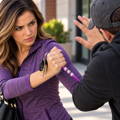
⭐ How Does a Kubotan Work?
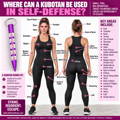
⭐Where Can a Kubotan Be Used in Self-Defense?
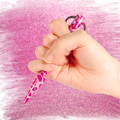
⭐Two Common Kubotan Grips
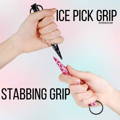
One of the most recognizable ways to hold a kubotan is sometimes called an icepick grip. The tool is enclosed in the fist with an end extending from the bottom of the hand. This position can be used with a hammer-fist type movement.
A forward grip positions the kubotan so an end extends beyond the thumb side of the hand. This grip can support forward or downward defensive movements.
Neither grip is inherently useful if you cannot maintain it under pressure. Practice with an inert training tool and qualified instructor can help you learn how to keep your wrist stable, protect your fingers and avoid losing the kubotan during contact.
Avoid practicing full-force strikes on another person. Pads and other appropriate training equipment allow you to develop movement and accuracy without unnecessarily injuring a training partner.
“The Munio is an adaptation on the original kubotan with a modern twist.”
⭐ What About Swinging Your Keys?
One traditional kubotan concept involves attaching keys to the end and swinging them as part of a defensive technique. Although you'll still encounter demonstrations of this method, it has significant practical drawbacks.
Keys move unpredictably. Swinging a cluster of them can make the tool harder to control, and the motion requires more room than a compact strike. You can also lose your keys or your grip on the entire keychain.
A controlled grip on the kubotan itself is generally a more practical skill to prioritize. Your keys can make the tool easier to locate and carry without necessarily becoming the striking portion of the device.
⭐ Kubotans, Pocket Sticks and Modern Variations
The basic idea behind the kubotan has inspired many variations.
One example is the MUNIO Self Defense Keychain, which departs from the traditional cylindrical stick. It uses a flatter, contoured shape intended to fit into the hand while functioning according to the same general principle of concentrating force through a handheld self-defense tool.
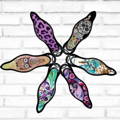
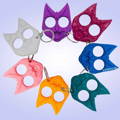
You'll also find pointed metal keychains, polymer pocket sticks, decorative keychain tools and products that combine kubotan-like features with other designs.
Choose a self-defense tool based on how realistically you can carry, access and use it, not simply because one design looks more aggressive than another.
⭐Is a Kubotan a Good Self-Defense Option for Teens?
⭐Are Kubotans Legal?
There is no responsible one-sentence answer to whether a kubotan is "legal everywhere."
Weapon definitions and restrictions vary by state and locality, and certain properties can impose additional restrictions. Schools, courthouses, government buildings, workplaces, entertainment venues and private businesses may prohibit items even when possession is otherwise lawful.
How the item is designed and how it is carried or used can also matter. A traditional blunt kubotan should not automatically be treated as legally equivalent to every pointed, spiked or modified self-defense keychain sold online.
Travel creates another consideration. TSA currently lists martial arts weapons as prohibited in carry-on bags and permitted in checked baggage. Because security personnel make the final determination about what is allowed through a checkpoint, although generally overlooked, don't assume that a small keychain self-defense tool will be accepted simply because it is attached to your keys.
Check applicable laws and property policies before carrying any self-defense weapon, particularly when traveling or entering a school or secured facility.
⭐ Training Matters As Much As The Tool
Perhaps the biggest mistake people make with personal safety products is believing that possession equals preparedness.
It doesn't.
A kubotan buried at the bottom of a purse won't help much if you can't reach it. One dangling from a keychain isn't automatically useful if you've never practiced getting a secure grip. And memorizing a collection of complicated pressure-point techniques isn't necessarily preparation for the confusion and speed of a real confrontation.
If you decide to carry a kubotan, learn how to use the specific style you own. Look for reputable self-defense or martial-arts instruction that includes realistic practice, safe training equipment and an emphasis on disengaging and escaping rather than staying in a fight.
Practice accessing the tool from wherever you normally carry it. Become familiar with your grip. Think through situations in which using it would be inappropriate as well as situations in which physical self-defense might become necessary.
⭐ Why the Kubotan Has Lasted for Decades
Self-defense technology has changed considerably, but the kubotan remains remarkably simple. It doesn't require charging. It doesn't expire like a chemical defense product. It is compact enough to integrate into something many people already carry every day.
Those advantages come with limitations. A kubotan is a close-contact tool, which means an attacker is already within reach when it is used. It does not provide the distance that other defensive options, like pepper spray can provide, and effective use requires you to maintain control of the tool during a physical confrontation.
However, it’s proven reliability, zero mechanical parts to fail and general acceptance across most campuses make the kubotan best viewed as one possible component of a broader personal-safety strategy.
Awareness, avoidance, boundaries, escape routes, communication and knowing how to summon help should always come before relying on a weapon. If physical self-defense becomes necessary, however, familiarity with a simple tool you can actually access and control can make a meaningful difference.
The best self-defense tool isn't necessarily the biggest, strongest or most intimidating one. It is one that is lawful for you to carry, appropriate for your circumstances, accessible when you need it and backed by enough training that you know what to do with it.
At Defense Divas®, we offer a diva-fantastic selection of self-defense products for women, including Bulletproof Clothing, Backpacks & Accessories, Pepper Sprays, TASER® devices, Stun Guns, Concealed Carry Purses, and more.
Copyright©2026 All rights reserved. This article or any portion thereof may not be reproduced or used in any manner whatsoever without the express written permission of Defense Divas®.