


Understanding Domestic Violence Patterns
🎯 Every year American women report over 2 MILLION injuries from intimate partner violence.
🎯 1 in 3 women in the United States reports experiencing violence by a current or former spouse, boyfriend or intimate partner at some point in her life.
🎯 Domestic Violence Hotlines receive an average 20,000 calls a day.
Domestic violence rarely begins with a black eye.
It often begins with control. A partner becomes increasingly jealous. He wants to know where you are, who you are talking to, what you are wearing, or why you took so long to answer a text. He criticizes your friends, creates problems when you spend time with family, monitors your phone, controls money, or convinces you that his behavior is simply proof that he loves you.
Understanding these patterns matters because intimate partner violence is not limited to physical assault. The CDC defines intimate partner violence as abuse or aggression within a romantic relationship and includes physical violence, sexual violence, stalking, and psychological aggression. Abuse can range from a single serious incident to a pattern that continues for years.
One of the best-known explanations for recurring abuse is the Cycle of Abuse. It can be a useful tool for recognizing certain patterns, but it should never be treated like a stopwatch. Not every abusive relationship follows the same stages, and an abuser does not have to move through every phase for the relationship to be dangerous.
“The Cycle of Abuse is eerily predictable in domestic violence according to Dr. Lenore E. Walker ”
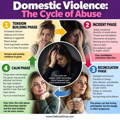
THE CYCLE OF ABUSE
Psychologist Dr. Lenore Walker introduced what became known as the Cycle of Violence in 1979. Her model described recurring periods of tension, violence, reconciliation, and calm that she observed in abusive relationships.
That model remains widely recognized, but domestic violence experts today emphasize something even more important: abuse is fundamentally a pattern of power and control. The National Domestic Violence Hotline no longer describes abuse as necessarily occurring in a predictable four-stage cycle because abusive relationships can be far less orderly. Some have little or no honeymoon period. Some involve constant intimidation rather than repeated physical assaults. Others escalate rapidly.
Still, understanding these four commonly recognized phases can help a woman recognize behavior that might otherwise seem confusing or contradictory.
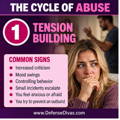
1. TENSION BUILDING PHASE
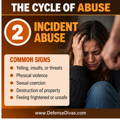
2. INCIDENT PHASE
3. RECONCILIATION PHASE

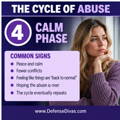
4. CALM PHASE
The calm or "honeymoon" period can be one of the most confusing parts of an abusive relationship because everything may suddenly feel normal again.
He may become the attentive, funny, loving man she fell in love with. The arguments stop. The threats disappear. They go out together. He helps around the house. He talks about their future.
• The victim may begin questioning how serious the incident really was.
• Maybe he really was stressed.
• Maybe it was a one-time event.
• Maybe things are finally different.
That temporary calm can reinforce hope and make leaving much more difficult. The National Domestic Violence Hotline notes that survivors may return to abusive partners multiple times and currently cites an average of seven attempts before leaving permanently. Financial dependence, children, housing, isolation, fear, threats, emotional attachment, transportation problems, and concern about what the abuser will do after separation can all make leaving extraordinarily complicated.
One important correction to a common piece of relationship advice: couples counseling is generally not recommended when abuse is present. Couples therapy assumes that both partners can participate safely and share responsibility for relationship problems. Abuse involves an unequal power structure, and information disclosed during therapy can sometimes be used against the victim later. Individual support from a professional experienced in domestic violence is a safer place to begin.
Here are some examples of things that occur in the Calm Phase of the abuse cycle.
✔️ Your partner may be extra attentive and “the good man” you imagined him to be.
✔️ The abuser is typically on his very best behavior during this phase.
✔️ It’s common for victims to begin second guessing their own feelings, and making excuses for the abuser’s behavior.
✔️ You may convince yourself that this was a one-time incident.
✔️ You may decide to put it behind you and move forward with even more conviction to make the relationship work or to “fix him”.
You may seek out a professional therapist for couples counselling (and he may agree to go initially!)
✔️ The relationship seems almost perfect.
“Research has shown, the average domestic violence survivor experiences violence 7 times before leaving her abuser.”
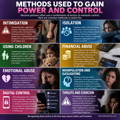
METHODS ABUSERS USE TO GAIN POWER & CONTROL
Physical violence may be the most visible form of domestic abuse, but control can be established long before anyone gets hit.
An abusive partner may use several tactics at the same time.
• Intimidation: Threatening looks, aggressive gestures, destroying property, punching walls, abusing animals, displaying weapons, driving dangerously, or behaving in ways designed to make you afraid of what could happen next.
• Isolation: Creating conflict with your friends and family, criticizing everyone close to you, discouraging outside activities, demanding constant access to your location, or gradually making you dependent on him for your social life.
• Using children: Threatening to take the children, using them to deliver messages, involving them in adult conflicts, undermining your parenting, or threatening custody battles if you leave.
• Financial abuse: Preventing you from working, sabotaging your job, controlling bank accounts, giving you an allowance, hiding financial information, running up debt in your name, taking your money, or requiring you to account for every dollar.
• Emotional abuse: Insults, humiliation, constant criticism, degrading comments about your appearance or intelligence, deliberate embarrassment, and attacks designed to erode confidence.
• Manipulation and gaslighting: Denying events you clearly remember, rewriting what happened, shifting blame, insisting you are irrational, accusing you of causing his behavior, or making you question your own perception of reality.
• Digital control: Demanding passwords, reading private messages, monitoring social media, tracking a phone or vehicle, repeatedly checking your location, or using technology to stalk, threaten, impersonate, or harass you.
• Threats and coercion: Threatening to hurt you, himself, your children, family members, friends, or pets; threatening to expose private information; threatening immigration, financial, legal, employment, or custody consequences; or forcing you to do something through fear.
These behaviors should not be dismissed simply because physical violence has not occurred. A relationship can be abusive without bruises.
ASSESSING ABUSIVE BEHAVIOR CHECKLIST
Taking 60 seconds to review this checklist to evaluate the power dynamic in your relationship
USING INTIMIDATION
☑️· Intimidating looks, actions or gestures
☑️· Destroying your property
☑️· Abusing pets
☑️· Displaying weapons
USING ISOLATION
☑️· Isolation can also take the form of a complete lack of privacy and personal boundaries.
☑️· Controlling who your friends are
☑️· Checking your text messages or phone log
☑️· Limiting her outside involvement
☑️· Selling her on moving away from her network of family and/or friends.
USING YOUR CHILDREN
☑️· Making her feel guilty about her children.
☑️· Involving the children in arguments
☑️· Using the children to relay messages
☑️· Threatening to take the children if she leaves him.
USING FINANCES
☑️· Causing her to lose her job
☑️· Preventing her from keeping or getting a job.
☑️· Giving her an allowance.
☑️· Making her ask for money.
☑️· Taking her money.
☑️· Intentionally keeping her in the dark about family finances and income.
USING EMOTIONAL ABUSE
☑️· Gas lighting to get a reaction from you
☑️· Derogatory comments on your physical appearance
☑️· Making jokes about your intelligence.
USING MANIPULATION
☑️· Making her think she’s crazy
☑️· Twisting the abuse around to make it out to be all her fault.
☑️· Flat out denial that the abuse happened.
☑️· Shifting responsibility.
☑️· Withholding a sincere and authentic apology as a second form of further abuse.
USING MALE PRIVILEGE
☑️· Making all the big decisions without consulting her.
☑️· Master of the Castle attitude
☑️· Treating her like his servant.
USING THREATS/EXTORTION
☑️· Making threats to do something to hurt her.
☑️· Holding something over her head to keep her from reporting the abuse.
☑️· Making her drop charges.
☑️· Making her do illegal things that can be used for extortion later to keep her under his control.
☑️· Threatening to child protective services on her if she leaves.

DEVELOP A PERSONAL SAFETY & ESCAPE PLAN
If you recognize these patterns in your relationship, think about safety before confrontation.
The most dangerous time in an abusive relationship is when the victim is trying to leave the attacker. Seek professional guidance on the safest process for your specific situation and involve the police to ensure a safe exit strategy.
Leaving an abusive relationship can be a particularly dangerous period because separation threatens the control the abusive partner has been trying to maintain. A carefully planned exit may therefore be safer than announcing that you are leaving during an argument or attempting to confront the abuser alone.
A personalized safety plan can include identifying safer areas of the home with exits, keeping access to a phone when possible, establishing trusted people you can contact, documenting threatening messages or injuries when it is safe to do so, identifying somewhere you could go, planning for children and pets, and setting aside important documents, medications, money, and necessities where they cannot easily be taken from you.
Be cautious with technology if you believe your phone, computer, accounts, vehicle, or internet activity may be monitored. Searching for shelters, attorneys, domestic violence resources, or escape plans on a device controlled by an abusive partner can expose what you are planning.
You do not have to solve the entire situation before asking for help.
The National Domestic Violence Hotline is available 24 hours a day. Call 1-800-799-SAFE (7233), text START to 88788, or use live chat through TheHotline.org. If you are in immediate or life-threatening danger, call 911.
Recognizing a pattern does not mean you have to wait for the next phase to prove that something is wrong.
Threats matter. Control matters. Stalking matters. Sexual coercion matters. Intimidation matters. Violence matters.
When someone repeatedly uses fear, manipulation, isolation, threats, or force to control another person, the warning is already there.
Protect yourself today from domestic violence. At Defense Divas®, we offer a diva-fantastic selection of self-defense products for women, including Bulletproof Clothing, Backpacks & Accessories, Stun Guns, Pepper Sprays, TASER® devices, Concealed Carry Purses, and more.
Copyright©2026 All rights reserved. This article or any portion thereof may not be reproduced or used in any manner whatsoever without the express written permission of the author.