

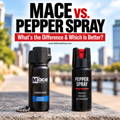
“Mace® is only the brand name of one pepper spray manufacturer."
Mace. Pepper Spray. What’s the Difference?

⭐What's in Pepper Spray?
Just like the name pepper spray implies, the effective ingredient in this self-defense product is derived from hot peppers. The oil essence of the pepper contains a chemical called oleoresin capsicum.
The primary active ingredient in conventional pepper spray is oleoresin capsicum, usually abbreviated as OC. It is an extract derived from hot peppers and contains capsaicinoids, the compounds responsible for the intense burning and irritation associated with pepper spray exposure.
When comparing pepper sprays, you may encounter several different measurements, particularly OC percentage, Scoville Heat Units (SHU) and Major Capsaicinoids (MC). These measurements are related, but they do not mean the same thing. Understanding the differences can help you make a better comparison instead of simply assuming the product displaying the largest number is automatically the strongest.
Let's take a closer look at how the effectiveness of pepper spray and mace are measured:
⭐Percentage of pepper spray concentration
⭐SHU (Scoville Heat Units)
⭐Major Capsaicinoids (MC)

⭐Percentage of Pepper Spray Concentration
OC percentage tells you how much oleoresin capsicum is present in the pepper spray formulation. Manufacturers commonly provide an OC percentage as one of the specifications for their defensive sprays, and formulations on the consumer market can vary considerably.
The key ingredient in all pepper sprays is oleoresin capsicum (‘OC’ for short). This is just a really fancy horticultural term for pepper juice. The ‘OC’ in pepper sprays can range from the relatively mild jalapeno to the extremely hot habanero. This is where the Scoville Heat Units (‘SHU’) for a pepper spray come into play.
OC percentage can also have legal significance. Most states do not establish a specific maximum OC percentage for civilian pepper spray, but some do. Michigan currently limits qualifying self-defense spray to no more than 18% OC, while Wisconsin limits qualifying pepper spray to no more than 10% OC. Other states may regulate defensive spray by Major Capsaicinoid concentration, canister size, formulation, purchaser age or method of sale instead.
Most pepper spray products sold to the public range between 10-18% pepper spray concentration. However, the percentage of concentration is only one factor to be considered when selecting an effective pepper spray defense weapon.
OC percentage is useful information, but it should not be viewed as the only measurement of pepper spray strength. Think of OC percentage as one part of the picture. It tells you how much OC is in the formulation, but it does not necessarily tell you everything about the potency of that OC.
A pepper spray device may have a low percentage of concentrated OC but that doesn’t mean it is not effective. It may be extremely powerful because of the particular pepper ingredient (OC) used.
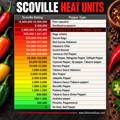
⭐Scoville Heat Units (SHU)

⭐Major Capsaicinoids (MC)
A third measurement you may encounter is Major Capsaicinoids, usually expressed as a percentage. Major capsaicinoids include the principal pungent compounds responsible for the physiological effects of OC pepper spray.
MC concentration can be particularly useful because it provides information about the concentration of the active pepper compounds in the finished formulation rather than simply the amount of OC used to make it.
That doesn't make OC percentage or SHU irrelevant. Each measurement tells you something different. OC percentage tells you how much oleoresin capsicum is in the formulation. SHU describes the heat or pungency associated with the pepper extract. MC concentration provides another way to evaluate the concentration of the active capsaicinoids.
When comparing defensive sprays, consider all of the information provided by the manufacturer instead of choosing a product solely because one number on its label is larger.
“Defensive sprays are rated on the oleoresin capsicum concentration and Scoville Heat Units index.”
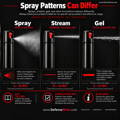
⭐Pepper Spray Patterns and How They Affect Self-Defense
Pepper spray isn't always a cloud of aerosol mist. Defensive sprays are available in several delivery patterns, and the pattern you choose affects range, accuracy, susceptibility to wind and the possibility of contaminating the surrounding area.
• Stream Dispersion: A stream defensive spray pattern projects a relatively narrow line of liquid toward the target. The concentrated pattern generally offers better directional control and less airborne contamination than a broad mist. It can be a good option outdoors, but the narrower stream requires more accurate aim.
• Cone/Fog Dispersion: A cone or fog disperses pepper spray across a wider area. The broader pattern makes pinpoint accuracy less critical, which can be beneficial during a rapidly developing confrontation. The disadvantage is that more of the formula becomes airborne. Wind can move the spray away from your intended target or back toward you, while indoor deployment can expose other people and contaminate a larger area.
• Gel Dispersion: Pepper gel uses a thicker formulation that travels in a concentrated stream rather than dispersing into a broad aerosol pattern. Because the gel is heavier and less likely to become airborne, it can reduce the potential for wind blowback and cross-contamination. Pepper Gel also tends to require more deliberate aiming because you are placing a narrow stream onto the attacker's face rather than creating a wider cloud.
• Foam Dispersion: Pepper foam produces a thicker coating that adheres to the area it strikes and can also reduce airborne contamination. Like gel and stream formulations, however, its narrower delivery means accurate placement becomes more important.
There isn't one spray pattern that is automatically best for everyone. Consider where you are most likely to carry the product. Someone who regularly walks, hikes or runs outdoors may prioritize resistance to wind. Someone primarily concerned about home defense may place greater importance on limiting contamination inside enclosed spaces.
Whatever pattern you choose, read the manufacturer's specifications for your particular spray. Don't assume that the range or deployment characteristics of one pepper spray apply to another.
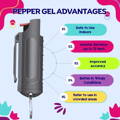
⭐Features to Look for in a Self-Defense Pepper Spray
Pepper formula gets most of the attention, but the physical design of the canister can make an enormous difference when you are frightened and have only seconds to react.
Start with the safety mechanism and actuator. A defensive spray needs protection against accidental discharge, but you should also be able to deliberately disengage the safety without staring at the canister. Flip-top, twist-lock and other locking actuator designs are available. The important thing is becoming thoroughly familiar with the mechanism on the spray you actually carry.
Keychain adaptability can be especially useful with compact sprays. Accessibility matters. A pepper spray canister buried underneath your wallet, makeup, keys and everything else in your purse isn't going to do much good during a rapidly developing confrontation. Key rings, quick-release attachments and dedicated exterior carrying locations can make a small defensive spray easier to reach.
Some pepper sprays contain UV identifying dye. The invisible marking dye can remain detectable under ultraviolet light and may potentially assist law enforcement in identifying a person who has been exposed to the spray.
Some canisters incorporate additional self-defense tools, including a pointed or kubotan-style end. These designs give the carrier another defensive option if an attacker has already closed the distance and the spray cannot effectively be deployed.
An integrated LED light can also serve a practical purpose. It can help you locate a door lock, illuminate the area immediately in front of you or provide enough light to better identify what you are dealing with before deploying a defensive spray.
A glow-in-the-dark actuator or locator feature can make the spray easier to find in darkness. That can be useful when locating a canister on a nightstand, inside a dark vehicle or in a bag.
Extra features can be valuable, but don't let bells and whistles overshadow the fundamentals. A dependable defensive spray with an appropriate pattern, secure safety mechanism and actuator you can confidently operate is more important than accumulating features you may never use.

⭐Self-Defense Spray Effects
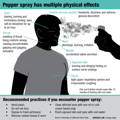
OC pepper spray primarily affects the eyes, skin and respiratory system. Exposure can cause intense burning and irritation of the eyes and skin, tearing, involuntary eye closure, coughing and irritation of the nose and respiratory tract. These effects can interfere with an attacker's ability to see clearly and continue an assault, potentially creating the opportunity you need to escape.
That last point is important. Pepper spray should be viewed as an escape tool, not a guarantee that an attacker will become completely helpless.
People can respond differently to defensive spray, and environmental conditions, accuracy and the amount of spray delivered can affect the result. Never remain within reach simply to see how well the spray worked. If you are legally justified in deploying pepper spray to defend yourself, the objective is to interrupt the attack, create distance and move toward safety.
Pepper spray can also affect the person using it. Wind, confined spaces and overspray can expose you or innocent bystanders, which is another reason to understand the delivery pattern of the product you carry.
Finally, don't buy pepper spray, drop it into your purse and assume you are prepared. Read the manufacturer's directions. Learn how the safety mechanism operates. Know which direction the nozzle faces by touch. Check the canister periodically for damage and pay attention to the manufacturer's expiration or replacement recommendations.
If an inert training version of your particular spray is available, practicing with it can help you become familiar with your grip, actuator, aiming and spray pattern without exposing yourself or someone else to OC.
The effects of mace and pepper spray on an attacker are impressive. The concentrated burst of oleoresin capsicum immediately effect the soft tissue parts of the body as it causes a violent reaction which includes:
• Restriction of the lungs
• Burning and swelling skin
• Severe nasal/sinus irritation
• Tearing, swelling and burning eyes
• Gasping, gagging and wheezing
• Blepharospasm
• Non-permanent blindness
• Larynogospasm
• Inability to speak
• Increased blood pressure
• Severe headache
Copyright©2026 All rights reserved. This article or any portion thereof may not be reproduced or used in any manner whatsoever without the express written permission of Defense Divas®.